
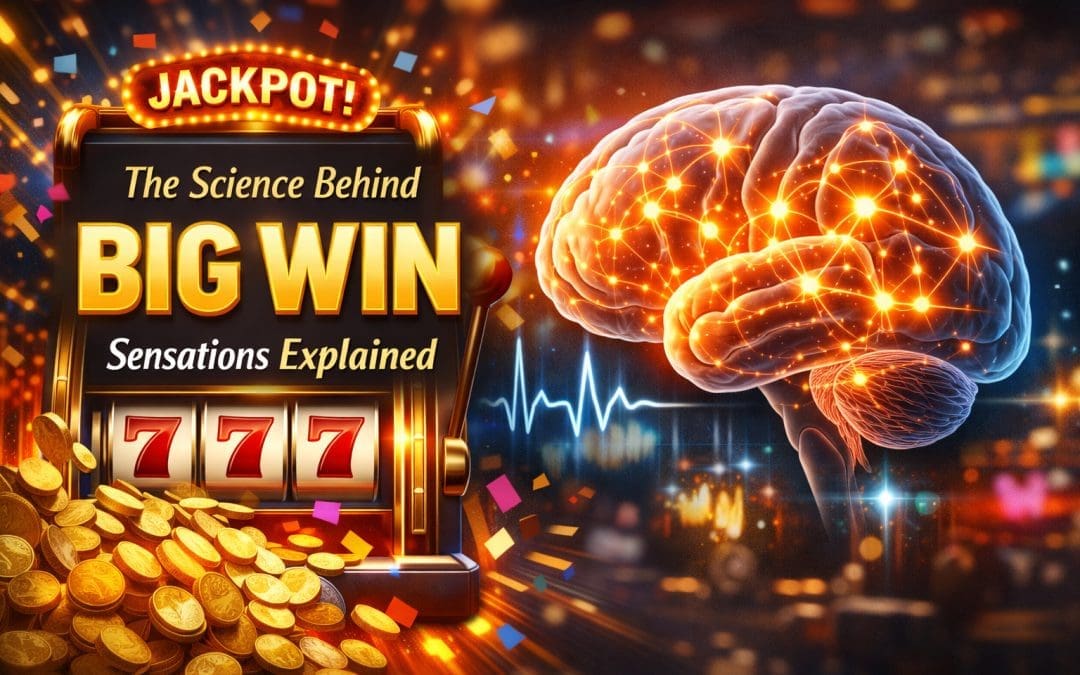
The thrill of hitting a huge slot machine jackpot is a unique sensation that disrupts all else. People stop talking mid-sentence. Heads turn. Even those who have been losing money for hours feel an instant sense of optimism.
I’ve seen this happen dozens of times in live casinos. For an hour or more, a gambler quietly spins a machine, then suddenly leans forward. The machine erupts in a burst of color and sound. Coins fall onto the screen. Their breathing slows. Their posture changes. Everything about them changes.
This isn’t just excitement. It’s the intersection of chemistry, circuitry, conditioning and prediction inside the brain.
What appears to be pure chance is actually a carefully crafted neurological event.
The Science of Big Wins
At the core of every big win sensation is one ancient system in the brain: the Mesolimbic Reward Pathway. This system developed long before there were casinos. It helped humans determine which behaviors to repeat. Find food. Shelter. Bonds.
Casinos and slot machines exploit that same wiring in the brain.
Dopamine and the Reward Rush
Dopamine is commonly referred to as the “pleasure chemical.” While this is somewhat true, it doesn’t tell the whole story. Dopamine is really about motivation, anticipation, and learning.
Dopamine asks one question: was that better than I thought it would be?
When you hit a big payout, neurons in the Ventral Tegmentum Area (VTA) flood the Nucleus Accumbens (NAcc) with dopamine. The NAcc serves as a reward amplifier, strengthening the connection between neurons associated with the last thing that occurred. Your brain identifies the experience as significant.
This is why big win sensations can feel electrifying. Players will describe a sudden warmth in the chest, tingling in the arms, or a surge of alertness. This is not the product of imagination. This is the nervous system entering a high-reward state.
More interesting still, dopamine release is highest when rewards are uncertain. This concept is known as reward-prediction error. When an outcome is greater than predicted, dopamine release is significantly increased. Because slot machines are designed to take advantage of this principle, the unpredictability of each spin creates a heightened sense of anticipation.
If each spin resulted in a predictable outcome, the thrill would diminish.
As mentioned earlier, the brain responds to uncertainty.
How Your Brain Lights Up on a Win
FMRI brain imaging studies that examine the brains of participants engaging in various forms of gambling during big wins demonstrate clear activation in several areas:
The Nucleus Accumbens shows great activity, indicating the value placed upon the reward and learning processes.
The Prefrontal Cortex demonstrates increased activity, evaluating the significance and planning for future decision-making. However, as noted above, repeated gambling can impair the function of this region, resulting in reduced impulse control.
The Amygdala assigns emotional significance to the event and encodes the experience as exciting and memorable.
The Hippocampus stores context-based information, such as the machine used, sounds, and environment. This results in what some researchers refer to as emotional tagging. The brain doesn’t simply store the experience of a big win; it stores all the details related to it.
- The chair.
- The Lighting.
- The Music.
This is part of the reason that players return to the same machines or locations. The brain associates those cues with possible reward.
Psychological Triggers in Gambling
While neuroscience addresses the chemical response, psychology provides insight into the reasons that those sensations become so captivating and enduring.
The thrill of gambling isn’t just about winning. It is also about anticipation, detecting patterns and perceiving control.
False Hope and Near Misses
One of the most potent factors contributing to triggering the thrill of a big win is a factor known as the near miss phenomenon.
This occurs when a slot machine displays a result that appears to be nearly identical to a jackpot. The three symbols required for a jackpot appear, and the final symbol falls one spot short. Or the reels slow dramatically before displaying a losing symbol.
From a logical standpoint, a near miss is no different than a loss.
However, from an emotional standpoint, a near miss is often perceived as being a different animal.
Research indicates that near misses stimulate the same reward pathways as actual wins, especially within the Nucleus Accumbens. The brain perceives near misses as indicators of progress, not failure.
Therefore, the brain perceives near misses as evidence that success is approaching.
In terms of neural function, near misses increase motivation. The urge to continue playing is enhanced. This is why near misses typically contribute to faster subsequent spins. The brain becomes more engaged, not less.
Random Rewards Explained
Variable ratio schedules were first described by B.F. Skinner in his work on operant conditioning. He demonstrated that animals will press levers more frequently to receive random rewards than consistent rewards.
Slot machines operate according to the exact same variable ratio schedule.
Instead of providing a reward every 10th spin, slot machines provide random rewards. Some rewards are provided rapidly. Others are delayed by long periods of time.
The randomness of rewards makes the behavior resistant to extinction. In simpler words, it is difficult for players to stop.
The brain expects the next spin to be the one.
This anticipation is a major component of the thrill experienced by players of slot machines. Not only do players experience a dopamine surge when they win, but also when they think they might win.
The anticipation itself becomes rewarding.
Conditioning and Sensory Cues
Over time, the visual and auditory components of gambling environments become conditioned stimuli.
- The flashing lights.
- The celebratory tones.
- The vibrating machine.
These stimuli become linked to the release of dopamine through classical conditioning.
Eventually, the cues themselves can evoke excitement prior to any outcome.
For example, the mere act of walking into a casino can elicit a physiological response due to past positive reward experiences.
The sensory overload win experience enhances emotional participation. The anticipation creates a continuous feedback loop.
Why Big Wins Are So Thrilling
The thrill experienced by players of slot machines as a direct result of the brain’s response to a big win cannot be solely attributed to dopamine. Several neurotransmitters combine to create the complete experience.
Role of Anticipation
Anticipation is arguably the most powerful emotion experienced by humans.
Anticipation activates attention systems, increases heart rate and primes the body for action.
Because slot machines are specifically designed to prolong anticipation, the reels of the machine are allowed to rotate slowly enough to create suspense. The sounds of the machine increase in intensity. The visual cues build toward the outcome.
This is what psychologists term an excitement cascade.
With each successive moment of uncertainty, the emotional commitment of the player increases.
The brain is completely invested in the possibility of a reward.
Interestingly, anticipation can sometimes generate more dopamine than the win itself.
The uncertainty is what generates the dopamine.
Euphoria and Endorphins
When a big win is achieved, endorphins are released in addition to dopamine.
Endorphins are natural opioids created by the brain. They reduce pain and create feelings of pleasure and well-being.
This contributes to the “jackpot” sensation reported by players. Some players report experiencing dizziness, while others report feeling invincible for a period of time. Perceptions of time may change. The experience is intensely vivid.
Serotonin also plays a role in regulating mood and creating feelings of satisfaction, thus stabilizing emotions.
Together, dopamine, endorphins, and serotonin create an multi-layered emotional experience. It’s not just the excitement. It’s a comprehensive neuro-chemical response.
Memory and Emotional Imprinting
Big wins create a strong memory.
Emotional experiences that are highly intense activate the amygdala, which enhances memory storage.
As a result, the memory of a big win is likely to be stronger than the memory of a series of losses.
Even if a player ultimately lost money at the end of the session, the memory of a single large win may overshadow the accumulated losses.
Additionally, the brain weighs emotionally charged experiences disproportionately.
The Casino Jackpot Effect and Machine Design
Designers of modern slot machines have been intentionally developing designs that optimize neural involvement.
Contemporary slot machines utilize a combination of visual, auditory, and tactile feedback to intensify the perception of reward.
Celebratory graphics, for example, emphasize the magnitude of a win. Even small payouts can elicit elaborate reactions.
This creates what is known as the perceived win effect. Players perceive rewards, regardless of whether the total balance is increasing or decreasing.
Progressive jackpots further amplify anticipation. The display of large progressive jackpot amounts stimulates the imagination and reward prediction mechanisms of players. The opportunity to win large sums of money can greatly intensify emotional commitment.
Designers of slot machines carefully calibrate the timing of rewards, the frequency and volume of sounds, and the pacing of visuals to maintain player engagement.
Again, this is intentional and is based on decades of behavioral psychology research. The goal of designers is to maintain engagement by continuing to activate the reward system without overwhelming it.
If too many rewards were available, the excitement would decrease.
If too few rewards were available, motivation would decrease.
The optimal level of rewards provides sustained engagement.
The Darker Side of the Experience
While the same neuro-chemical reward mechanisms that create the thrill of a big win also create vulnerabilities, the two concepts are not mutually exclusive.
Repetitive stimulation of the reward pathway can alter the function of the brain over time.
Addictive Mechanisms and Risks
Addiction neuroscience research indicates that repetitive dopamine surges can reduce baseline sensitivity. This means that the usual activities of daily living can feel less rewarding than the thrill of gambling.
Over time, the brain learns to associate gambling as the primary source of stimulation.
Tolerance can develop. Players may need to place larger bets or spend longer sessions to obtain the same emotional reaction as previously obtained.
Impulse control can be impaired as the prefrontal cortex is weakened over time as a result of prolonged exposure to the stimulation of gambling.
Players may lose the ability to stop despite acknowledging intellectually that losses exceed winnings.
The Habit Loop of Gambling
A habit loop is formed when cue, anticipation, action and reward are repeatedly combined. Thousands of repetitions of this process can transform the habit loop into an automatic response.
Chasing the High
One of the most powerful motivations for continuing to gamble is the memory of previous large wins. The brain vividly replay memories of those experiences.
This creates an expectation that the sensation can be reproduced.
As a result, loss chasing psychology develops.
Players believe that the next large win can restore both monetary and emotional excitement.
Even after extended losing streaks, the memory of previous dopamine surges motivates players to continue.
This is why the addiction pattern of the big win can be so persistent.
The brain recalls the high more clearly than the losses.
Scientifically Proven Methods for Managing the Thrill Responsibly
While understanding the neuroscience behind gambling does not eliminate the emotional attraction of the thrill of a big win, it can provide tools to manage the behavior.
The most successful methods focus on disrupting the automatic reward loop and allowing the player to regain control of their decisions.
Below are scientifically proven methods grounded in behavioral science:
- Set a strict financial limit prior to beginning and treat the established limit as if you have already spent it. This prevents the tendency for reward-driven escalation during play.
- Take regularly scheduled breaks (every 20-30 minutes). This allows the dopamine levels to recover and helps prevent impulsive decision making.
- Do not chase losses. Research has shown that the likelihood of recovering financially from a loss is rare and the likelihood of recovering emotionally is virtually nonexistent.
- Pay attention to physical signs of rising neural arousal (increased heart rate or tension).
- Remind yourself that each outcome is independent and not related to the preceding or succeeding outcomes, regardless of how they may seem to be related.
These techniques are effective because they engage the prefrontal cortex to help establish rational thinking and control over emotional impulses.
They interrupt the automatic reward cycle.
Identifying Manipulative Design Elements
By recognizing how machines manipulate the brain’s reward system, gamblers can reduce the psychological appeal of the machine.
There are several common design elements of slot machines that can cause the brain to respond in a way that is similar to the way it responds to a reward:
- Near-miss animations that give players the illusion that they almost won.
- Celebratory sounds for small wins that exaggerate their relative size.
- Slowing the reels of the machine to increase anticipation.
- Providing frequent, small wins to keep the player engaged with minimal gain.
- Displaying the progressive jackpot amounts instead of the odds of winning.
Recognizing these elements can help gamblers view the machine as predictable and therefore less exciting.
Why the Sensation Persists
The scientific explanation of the thrill experienced by gamblers from big wins reveals a great deal about the nature of humans.
The reward system that was developed in humans to encourage persistence, exploration, and learning in unpredictable environments continues to be triggered by the mechanisms of slot machines.
The neuro-chemical response to a big win is not a deficiency. It is a feature of how the brain learns.
The reason that slot machine thrill experiences are so powerful is the result of the combination of the unpredictability of each spin, the anticipation of a reward, the sensory stimulation, and the emotional reinforcement.
Very few activities stimulate all of these systems simultaneously. Even after understanding the mechanisms involved, the experience itself does not diminish. The lights still flash. The hearts still beat faster. The dopamine still flows.
The key distinction is consciousness. Having an understanding of the underlying mechanics of the brain provides individuals with the ability to disconnect from the experience. The experience is still thrilling. But it is no longer mysterious. And with that comes something vital. Choice